
Picture a Tuesday night in a Singapore flat. A three-year-old has a cough again, her third since school started. Her mother sits on the edge of the bed with a thermometer in one hand and her phone in the other, searching for the nearest clinic still open. She will find one. She almost always does. But each visit lands with a different doctor, and each doctor sees a cough, not a pattern.
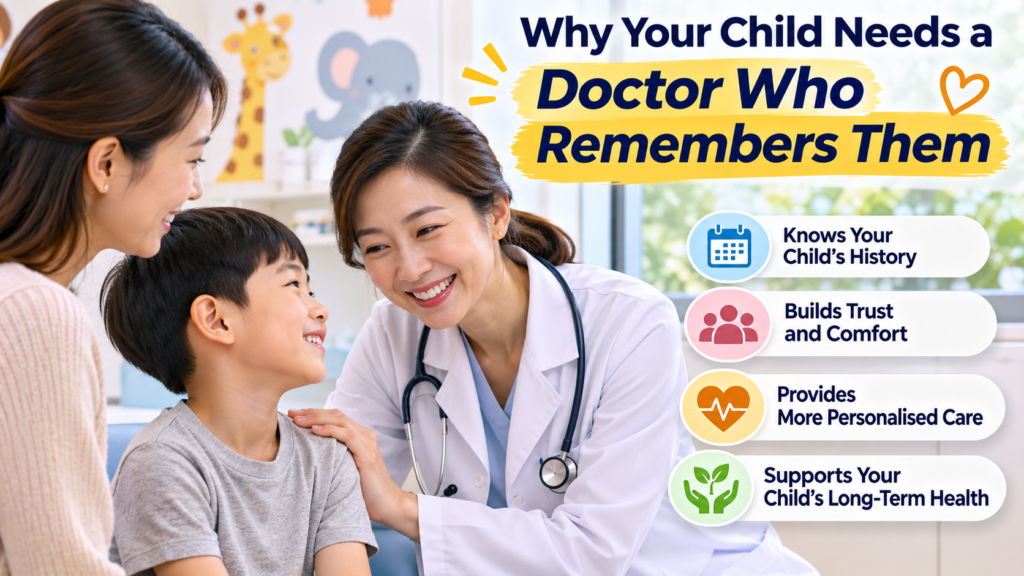
That gap is the quiet problem in how many families handle their children’s health. Care is easy to find here. Continuity is harder. If you are deciding when a children’s specialist makes sense, it can help to read how a clinic offering paediatrics in Singapore describes its services, because it shows what a regular paediatric relationship covers beyond the sick visit. The rest of this guide is about building that relationship on purpose.
One Visit Only Shows One Day
A doctor who meets your child once sees a snapshot. One cough is ordinary. Four coughs in a single term might be ordinary too, or they might be worth a closer look. The only way to tell the difference is to see them side by side.
Children also change fast. Height, weight, speech, sleep and the way they move all shift from month to month. A doctor who saw your child at nine months can compare. A doctor meeting them for the first time at two can only guess what normal looked like before.
GP or Paediatrician, a Simple Rule
Here is a rule you can use at the kitchen table. Ask yourself whether your worry is about today or about a trend.
If it is about today, such as a cold, a tummy bug or a scraped knee in a child who is otherwise well, a family doctor you trust will usually handle it well. If it is about a trend, such as growth, feeding, development, sleep, repeated illness or a long-term condition, a paediatrician is the better fit. Paediatricians complete specialist training in children’s health, and trends are exactly what that training is built to read.
One exception sits above the rule. If your child seems very unwell, is hard to wake, floppy or struggling to breathe, skip the clinic and go straight to a hospital emergency department.
The Trouble With the Nearest Clinic
The most common mistake is choosing a doctor by distance every single time. It is easy to see why parents do it. A sick child at night is exhausting, and the closest open door feels like the kindest choice.
The cost shows up later. Records end up spread across several clinics. You repeat the same history at every visit, and you sometimes repeat the same tests. Worst of all, the pattern that would have mattered never lands on one desk. A better habit is to pick one main doctor for routine and non-urgent care, use the nearest clinic only when you must, and then tell your main doctor what happened.
Keep a Simple Health Log
You do not need an app. A note on your phone works. Each time your child is unwell, jot down:
- The date the illness started and when it ended
- The highest temperature and how you measured it
- Any medicine given, with the dose and the time
- Anything new, such as a rash, poor appetite or a change at childcare
Now imagine the mother from that Tuesday night reading her log aloud: coughs in February, April, May and July, each starting about a week after a return to school, each lasting around ten days. In under a minute, the doctor has a story instead of a single scene. That is the kind of detail a busy appointment rarely uncovers on its own.
Make the Health Booklet Work Harder
Children born in Singapore are given a Health Booklet, which records vaccinations, growth and developmental checks. Many families leave it in a drawer between appointments. Bring it to every visit instead, including the quick ones.
The booklet is the one record that travels with your child, no matter which clinic you walk into. It also helps you keep track of the Ministry of Health’s National Childhood Immunisation Schedule, so a missed dose is spotted early rather than years later.
What a Good First Visit Looks Like
Try to book the first visit when your child is well. A calm appointment gives you room to ask questions without a fever pushing everyone along. Ask who will see your child next time, how you can reach the clinic after hours, and how records are kept and shared.
Then watch something small. Does the doctor speak to your child, not just to you? Do they kneel to eye level, or let a nervous toddler hold the stethoscope first? Those moments tell you a lot about how future visits will feel.
Finding a clinic in Singapore is rarely the hard part. Finding a doctor who knows your child is. Give one doctor the chance to see the whole story, keep your notes, carry the booklet, and the next time a cough turns up on a Tuesday night, someone will open the file and say, gently, that they have seen this before and know what to look for.